The challenge at a glance
The challenge has two tracks based on the same drone footage. Track 1 focuses on tracking birds, while Track 2 focuses on predicting their future movements.
Each track has its own leaderboard and prizes. Participants can enter either track or both.
Input to both tracks
Video30 fps

IMU Newyaw change, −5° to 0°
IMUground speed, 0 to 2.1 m/s
0 s7 s
This example shows 7 seconds of video and IMU data from a training sequence. The IMU records the drone's orientation and velocity and the pilot's gimbal and zoom commands in each frame. This information helps distinguish camera motion from bird motion.
Track 1 · Multimodal tracking
Where is every bird?
- Detect each bird and assign a bounding box to it in every frame.
- 185Assign each bird a tracking ID and keep it consistent across frames.
- Input: video + IMU. Scored by SO-HOTA
Track 2 · Trajectory prediction · new
Where will it be in 5 seconds?
- Observed 2 seconds
- Six predicted trajectories
- Actual bird trajectory
- Input: video + IMU. Stop predicting for a bird once it leaves the video frame. Scored by SO-HOTA-TP, proposed for this challenge
In Track 2, participants receive video rather than ground-truth bird trajectories. Their methods must first track the birds and then predict their future movements. A tracker developed for Track 1 can also be used for Track 2.
- Data & public test open
- Public test closes
- Code submission
- Results
- Paper deadline
- MVA2027, Fukuoka
Why this is hard
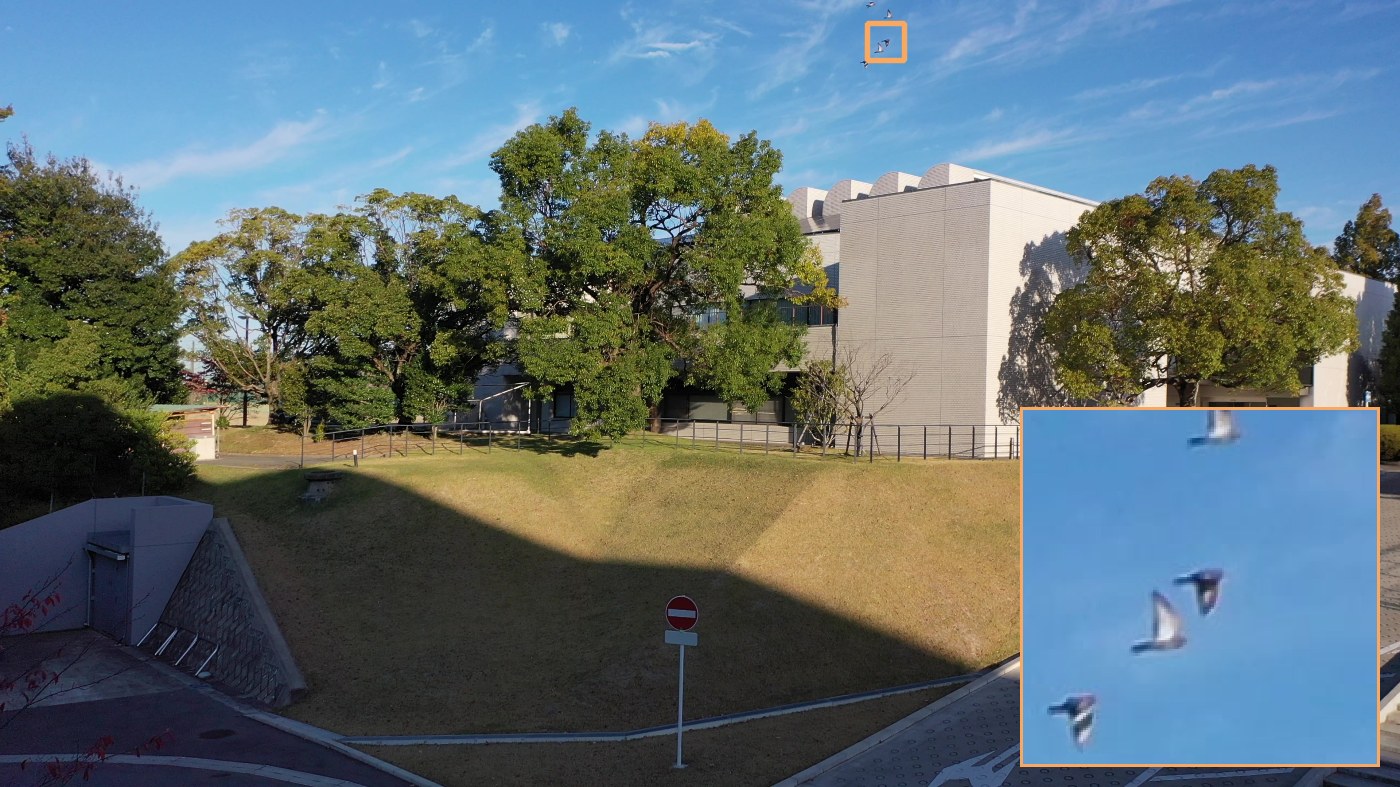
Small objects. Most birds are smaller than 32 × 32 pixels, making it difficult to match the same bird across frames based on appearance alone.
Camera and bird motion. Both the drone camera and the birds move in 3D, so their motions are mixed in the video. This makes tracking and prediction difficult, especially when the drone changes direction.
Birds disappearing from view. In the training data, 41% of the birds observed during a Track 2 input window disappear from view before the 5-second prediction period ends, for example by leaving the frame or becoming occluded. Methods must also predict when a bird will no longer be visible.
Different backgrounds. Birds are filmed against open skies, campus scenes, and rocky riverbeds. The baseline detector performs much better against open skies than against complex backgrounds such as rocks.
The Spotting Birds series
SMOTP4SB is the third challenge in a series held at MVA. The challenge has progressed from detecting birds in still images (2023), to tracking them in videos (2025), and now to predicting their future trajectories (2027).
-
MVA2023
SOD4SBSmall Object Detection for Spotting Birds
- Detection in single images
- 57,019 training images
- Ranked by mAP@50
- 200+ participants
-
MVA2025
SMOT4SBSmall Multi-Object Tracking for Spotting Birds
- Tracking across UAV video
- Introduced SO-HOTA (Dot Distance)
- 78 participants, 308 submissions
- Winner 5.1x the baseline
-
MVA2027
SMOTP4SBTracking and Prediction
- New: Track 1 is multimodal, video + IMU
- New: Track 2 predicts 5 s ahead
- New: SO-HOTA-TP, a proposed metric
- Track 1 keeps SO-HOTA
New in 2027:
- Track 1 now supports video and IMU data. Unlike MVA2025, which used only video, 27 of the 128 training sequences also include drone orientation, velocity, and the pilot's gimbal and zoom commands recorded for each frame. Participants may use this information to help distinguish camera motion from bird motion when tracking birds. Using IMU data is optional.
- Track 2, trajectory prediction. Predict 5 seconds ahead from 2 seconds of video, with the same IMU data available.
- SO-HOTA-TP: A new evaluation metric. Track 2 uses a newly proposed metric that treats a bird leaving the frame as part of the task. Its full definition will be presented in the MVA2027 challenge report.
Potential applications include preventing bird strikes near airports and wind farms, protecting crops and fisheries, and monitoring bird populations. These applications can benefit from knowing both the current positions of birds and where they are likely to fly next.